 English
 Español
  Português
  русский
  Français
  日本語
日本語  Deutsch
  tiếng Việt
  Italiano
  Nederlands
  ภาษาไทย
  Polski
  한국어
한국어  Svenska
  magyar
  Malay
Malay  বাংলা ভাষার
  Dansk
Dansk  Suomi
Suomi  हिन्दी
  Pilipino
  Türkçe
  Gaeilge
  العربية
  Indonesia
  Norsk
Norsk  تمل
تمل  český
český  ελληνικά
  український
  Javanese
  فارسی
فارسی  தமிழ்
தமிழ்  తెలుగు
  नेपाली
  Burmese
  български
  ລາວ
ລາວ  Latine
  Қазақша
  Euskal
  Azərbaycan
  Slovenský jazyk
  Македонски
  Lietuvos
  Eesti Keel
  Română
  Slovenski
  मराठी
मराठी  Srpski језик

Call Us
+86-13780696467
Email Us
sales@qdcomrise.com

What extruder screw design does a 110mm HDPE pipe machine typically require?
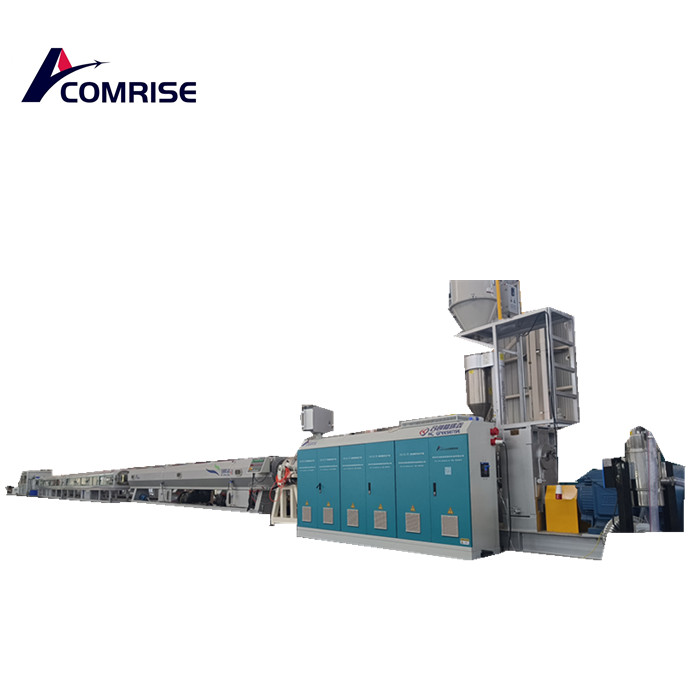
Comrise machine introduces practical insight into the core of the 110mm HDPE Pipe Machine production process, especially focusing on how extruder screw design directly affects pipe stability, melt quality, and long-term operational consistency in modern extrusion lines.
The design of the screw inside a pipe extrusion system is often underestimated, yet it is one of the most decisive components that determines whether a 110mm HDPE pipe line can maintain stable output at high speed while keeping uniform wall thickness and smooth surface finish. In industrial production environments where continuous operation is expected, even small variations in screw geometry can lead to visible changes in pipe quality.
Understanding Why Screw Design Matters in HDPE Pipe Extrusion
In polyethylene processing, material behavior changes significantly during heating, compression, and homogenization. The HDPE Pipe Machine must handle high melt throughput while ensuring the resin is fully plasticized without degradation.
The screw is responsible for three key functions:
- Conveying raw HDPE pellets forward
- Compressing and melting the material evenly
- Stabilizing pressure before it enters the die head
If any of these stages are not properly optimized, issues such as melt fracture, uneven wall thickness, or unstable output speed may occur. This is particularly important for medium-diameter pipe systems like 110mm, where precision balance between output and cooling speed becomes critical.
Typical Screw Structure Used in the HDPE Pipe Machine
Most modern extrusion lines designed for HDPE pipe production use a three-zone screw structure. This includes a feeding zone, compression zone, and metering zone. Each section is engineered with different geometry to control material behavior.
1. Feeding Zone
This is the entry stage where HDPE pellets are transported forward. Deep channels are typically used to ensure high intake capacity and stable feeding performance.
2. Compression Zone
Here, the channel depth gradually decreases. The material is compressed, melted, and mixed. This section is crucial for eliminating unmelted particles.
3. Metering Zone
The final stage ensures uniform melt pressure and stable output before entering the die head. This zone directly influences pipe wall consistency in a 110mm HDPE Pipe Machine.
High-Efficiency Screw Features in Modern Pipe Lines
In advanced extrusion systems developed by Comrise Machine, screw design is not only about geometry but also about thermal balance and mixing efficiency.
A typical high-efficiency screw used in HDPE pipe production includes:
- Optimized L/D ratio for stable plasticization
- Barrier structure or mixing sections for better melt homogeneity
- High torque compatibility for continuous high-speed operation
- Enhanced surface treatment for reduced wear and longer service life
These improvements are especially important when the line is required to run at higher output levels while maintaining consistent pipe diameter accuracy.
Comparative Overview of Screw Design Types
| Screw Type | Structural Feature | Main Advantage | Application Effect in 110mm Pipe Production |
| Standard Three-Zone Screw | Basic feeding-compression-metering | Stable general performance | Suitable for low to medium speed operation |
| Barrier Screw Design | Added barrier flight separation | Improved melting uniformity | Reduces unmelted particles in pipe wall |
| Mixing Section Screw | Special mixing elements included | Better color and material dispersion | Enhances structural consistency |
| High-Speed Optimized Screw | Increased L/D ratio + refined groove depth | Supports high output stability | Ideal for continuous 110mm HDPE Pipe Machine operation |
How Screw Design Impacts Real Production Challenges
In real production environments, operators often face several recurring challenges when running the HDPE Pipe Machine:
Uneven Wall Thickness
This is commonly linked to inconsistent melt pressure. A well-designed screw stabilizes pressure before extrusion, helping maintain dimensional accuracy.
Melt Degradation
Excessive shear or overheating can degrade HDPE molecules. Optimized screw geometry reduces shear hotspots and improves thermal balance.
Output Fluctuation
Unstable feeding or poor compression design can lead to irregular output speed. Modern screw systems reduce this risk by maintaining consistent material flow.
Energy Consumption Variations
Poor screw efficiency often leads to unnecessary torque load. Improved designs reduce resistance, lowering overall energy demand during continuous operation.
The Role of Multi-Layer Pipe Requirements in Screw Optimization
As pipe applications become more demanding, many extrusion lines now support two-layer or three-layer structures. This changes how screw systems are designed.
For example:
- Inner layer: requires strong bonding and structural stability
- Middle layer: often includes recycled or filler-enhanced materials
- Outer layer: focuses on surface quality and UV resistance
A 110mm HDPE Pipe Machine with multi-layer capability typically requires synchronized screw systems that ensure each layer maintains consistent flow behavior before merging at the die head.
Key Technical Design Considerations
Several engineering factors are commonly evaluated when designing screw systems for HDPE pipe extrusion:
- L/D ratio between 30:1 and 33:1 for balanced performance
- Compression ratio optimized between 2.5:1 and 3.2:1
- Deep-feed geometry for improved material intake
- Controlled shear zones to avoid overheating
- Wear-resistant alloy coating for long-term operation stability
These factors collectively determine whether the extrusion line can maintain consistent output over long production cycles.
Integration with Modern Control Systems
Screw performance does not operate independently. In modern extrusion lines, it works together with PLC-based control systems that continuously adjust temperature, pressure, and traction speed.
In systems used by Comrise Machine, synchronization between screw rotation and downstream equipment ensures:
- Stable pipe diameter control
- Accurate weight per meter regulation
- Reduced startup material waste
- Improved long-duration operational consistency
This integration is particularly important for the HDPE Pipe Machine, where small fluctuations can lead to significant material variation over long runs.
Operational Perspective on Screw Optimization
From a practical production viewpoint, screw design is not a static feature. It evolves with material types, energy requirements, and production speed expectations.
Operators often observe that:
- Small screw adjustments can significantly affect melt clarity
- Higher throughput requires better thermal stability control
- Multi-layer structures demand more precise pressure balancing
This is why modern extrusion systems continue to refine screw geometry rather than relying on traditional designs.
Conclusion
Extruder screw design remains a core engineering factor that defines the efficiency and stability of modern HDPE pipe production systems. In a 110mm HDPE Pipe Machine, the balance between melting efficiency, pressure stability, and material homogeneity is largely determined by how well the screw structure is optimized for continuous operation and multi-layer adaptability. The approach developed by Comrise Machine reflects how screw engineering, combined with coordinated control systems, supports consistent pipe quality across varying production conditions.
Send Inquiry



X
We use cookies to offer you a better browsing experience, analyze site traffic and personalize content. By using this site, you agree to our use of cookies.
Privacy Policy
News
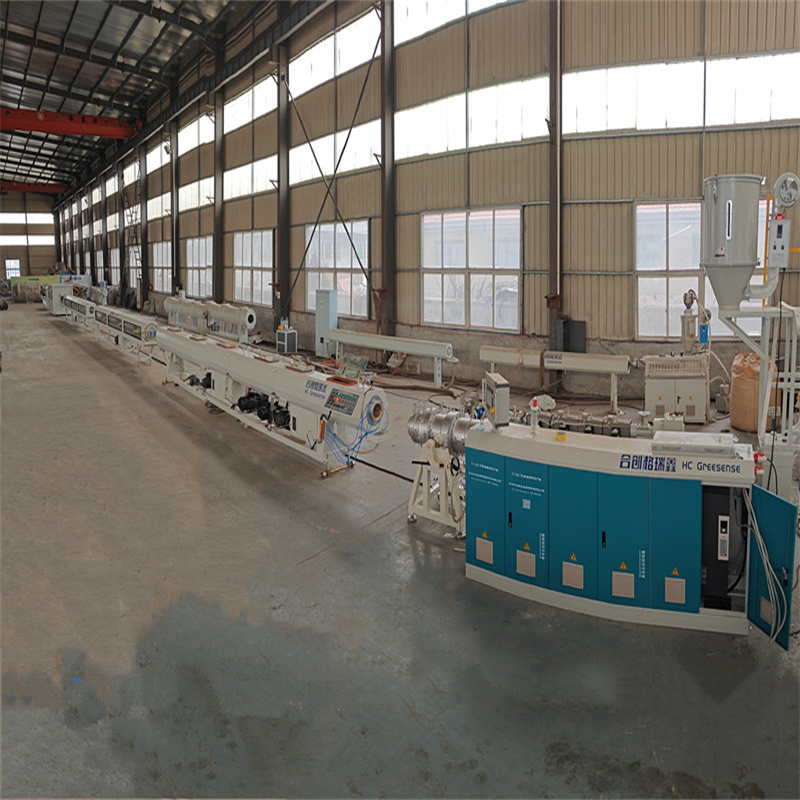 50-250mm High speed hdpe pipe machine sign contract with European customer2024/04/15
Comrise machinery specialized on high speed HDPE pipe machine manufacture and supply. The custom made HDPE pipe machine can make pipe from minimum 16mm upto 1600mm diameter. With fast delivery time for 30 days one pe pipe production line, and good after sale service, they can send experienced engine......
 Anhui customer ordered single-layer MPP power pipe machine production line on Apr.1th, 2024 year, pipe diameter 75-250mm.2024/04/07
The comrise high quality MPP power pipe machine has a 75/38 high-efficiency single-screw extruder, a 160kw motor, an 800G drying feeder, a machine head die, a core die, a sizing sleeve, one 9-meter vacuum water tank, and two 9-meter spray water tanks. It consists of a four-track tractor, a chipless ......